




An unserious torrent client written in Rust. Built for fun.
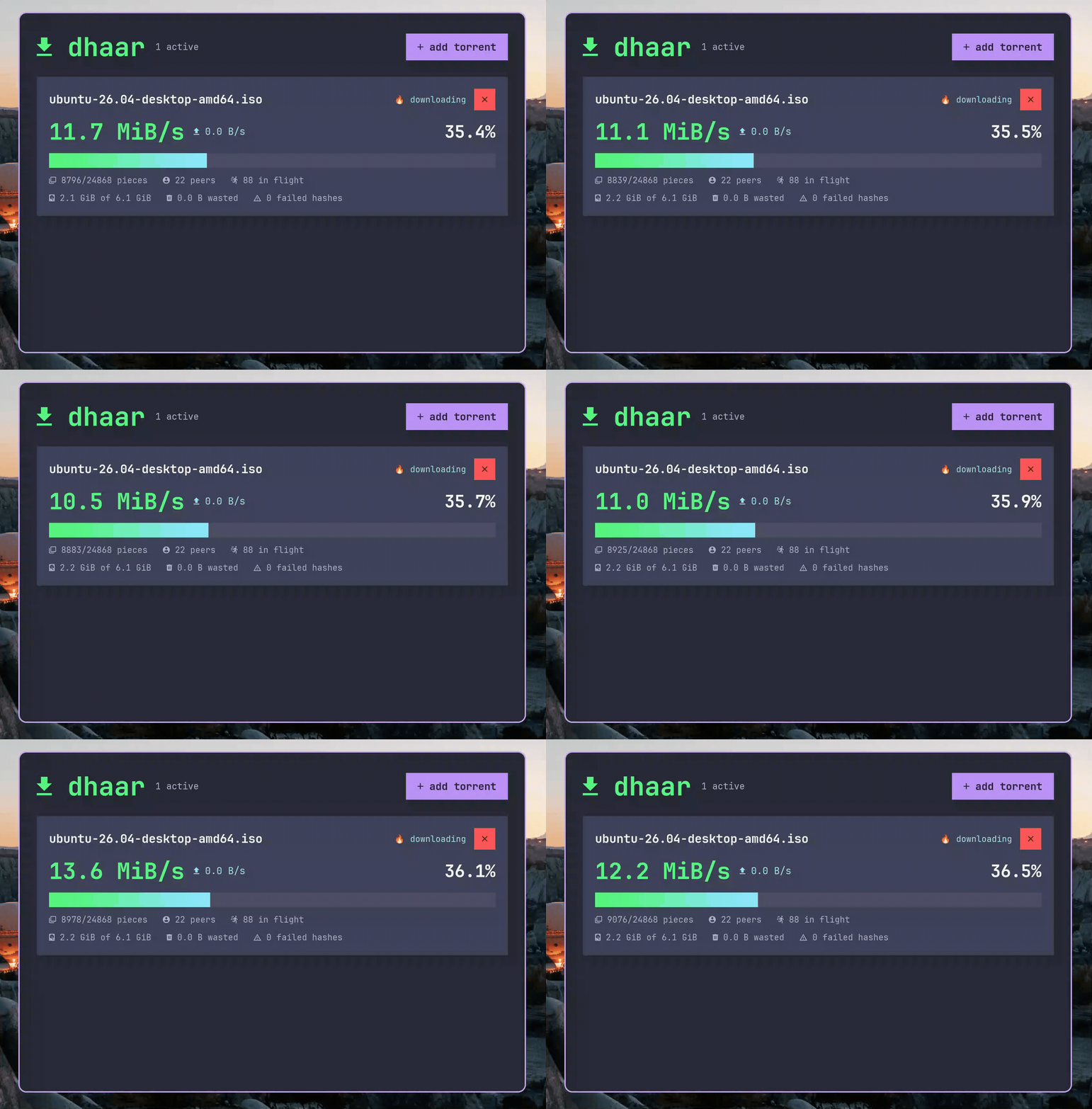
~60% complete, and a working download end to end. Peers are discovered over HTTP
trackers, connections are handshaked and framed with a tokio-util codec, blocks
are requested with pipelining, completed pieces are SHA-1 verified and written to
disk, and the finished download is split into the torrent's real file layout. The
last piece is short, and its block count, request lengths, hash check and disk
reads are all sized to it rather than to the full piece length.
The tail of a download does not stall behind one slow peer: once every remaining piece is spoken for, a second peer may take a piece somebody is already working, and whichever finishes first wins. Sharing is capped at two peers per piece — uncapped, peers pile onto whatever is nearly done and throw away more than the stall costs. The duplicate piece is counted as wasted rather than cancelled mid-flight, which on a realistic download comes to about 0.02% of the payload.
Peers can reach us, not just the other way round — the peer manager binds a TCP
listener and supervises accepted connections alongside dialled ones. A download
survives a restart: the partial .dhaar store is read back on start and its
verified pieces kept, which is what lets an instance come up already seeding.
The whole thing is a library. Download owns the wiring, hands back a handle,
and reports live status — bytes, rates, peers, pieces in flight, wasted bytes,
hash failures — which is what the GUI above is rendering.
Still missing: web seeds, DHT, UDP trackers, and magnet links.
- Trackers are the only peer source.
announceis optional andannounce-listalone is enough, but a torrent that ships neither — Arch Linux's ISO torrent, which carries only a BEP 19url-listof web seeds — parses fine and then finds no peers at all. It logs a warning and sits idle. - A resumed store is invisible to the tracker. Pieces recovered from disk
set the progress counters but never pass through
piece_verified, which is whatverified_bytescounts. An instance that comes up complete announcesleftas the full torrent length and never leavesDownloading, so trackers and peers read it as having nothing. - A store belonging to another torrent is never reclaimed. If the info hash
on disk does not match,
initializereturns no bitfield but leaves the old identity in place, so the same mismatch happens on the next start. That store rediscards its progress every time, silently and permanently. - The store format has no version. The trailer has grown once already, and a store written by an older build fails the size check and is laid out fresh — the payload survives but the bitfield is zeroed. There is no way to tell "old format" from "corrupt", which are opposite situations.
- Completion can go unreported. The status feed is sampled once a second, so a download that finishes and exits inside one interval never publishes its final state. The data is correct on disk; only the report is missing.
- Inbound connections are uncapped. The 50-connection limit is checked before dialling out, but nothing bounds how many we accept, and accepted peers draw on the same budget — enough incoming can crowd out dialling entirely.
- An inbound peer cannot be reconnected to. A peer that dials us is known only by the ephemeral source port it called from, which nothing listens on. The base protocol carries no way to learn the real one; that needs the BEP 10 extended handshake.
- Torrents without a
creation dateare rejected. The field isOption, but pairingOptionwith adeserialize_withand no#[serde(default)]makes serde require it anyway, so a valid file fails to parse. - A failed
accept()spins. The listener arm matches onOk(..), so an error falls through the pattern and the branch re-arms immediately; a persistent failure like running out of file descriptors becomes a busy loop.
cargo run -p dhaar-guiPress Add torrent to choose a .torrent file, and add as many as you like.
Paths given on the command line start immediately. See
examples/dhaar-gui for what it does and does not do.
dhaar-torrent <torrent_file> [OPTIONS]| Flag | Description |
|---|---|
-c, --config-file <PATH> |
Config file (default: ~/.config/dhaar-torrent/config.toml) |
-l, --listening-port <PORT> |
Port to accept incoming peers on, and the one announced to the tracker (default: 6881) |
dhaar-torrent ubuntu.torrent
dhaar-torrent ubuntu.torrent --listening-port 51413
Progress is logged once a second. RUST_LOG controls the detail:
RUST_LOG=dhaar_torrent=debug dhaar-torrent ubuntu.torrentuse dhaar_torrent::Download;
use std::path::Path;
let download = Download::from_torrent_file(Path::new("ubuntu.torrent"), 6881)?;
let mut updates = download.subscribe(); // taken before starting, so nothing is missed
// Held for as long as the download should live: dropping it stops the download.
let _handle = download.spawn(); // returns immediately
while updates.changed().await.is_ok() {
println!("{:.1}%", updates.borrow().progress() * 100.0);
}Downloads land in the current working directory. While in flight the data lives
in a single <name>.dhaar file; once every piece verifies it is split into the
torrent's real file layout.
cargo test --workspace covers the codec and parsing. Behaviour that only shows
up between two processes has its own scripts, each of which stands up a private
tracker and real client processes:
scripts/test-inbound.sh          # --keep on any of these retains the logs
scripts/test-repair.sh
test-inbound.sh runs a seeder and a leecher against each other, with the seeder
announcing into an empty swarm so it has nobody to dial — which is what makes
every byte that moves proof that an accepted connection carried it.
test-repair.sh hands two clients the same deliberately damaged store — a
complete bitfield, one piece whose bytes do not match its hash — differing only
in the flag byte. With the clean bit clear the client must re-hash and disown the
bad piece; with it set the client must take the bitfield at its word. The second
arm is what proves the flag gates the work rather than repair running
unconditionally.
scripts/bench-seeders.sh         # end to end: N seeders, one leecher, timed
cargo bench # divan; component costs of the store pathEvery figure below comes from one box, and none of them travel:
| CPU | Intel Core i7-12700H, 20 logical cores, SHA-NI |
| RAM | 15 GiB |
| Store | ext4 on LUKS-encrypted NVMe |
| Kernel / rustc | 6.18 LTS / 1.98.1, release build |
Seeders and leecher all run on this one machine over loopback, so the numbers describe what the client can do when nothing else is in its way — not what a real swarm would give you. See the caveats below before quoting any of them.
1 GiB payload, 256 KiB pieces, median of seven runs per arm:
| seeders | rate | vs 1 peer |
|---|---|---|
| 1 | 378 MB/s | 1.00x |
| 2 | 670 MB/s | 1.77x |
| 4 | 1088 MB/s | 2.88x |
| 8 | 1287 MB/s | 3.41x |
Runs after the first in each arm agree within 2–4%; the first is always slower, because the store has just been written and nothing is in page cache yet. The medians ignore that, which is the only reason seven runs rather than three.
Eight peers is the last arm that measures the client. Past it the harness runs 17 to 33 client processes against 20 cores — 846 OS threads at the widest — and the leecher starts competing with the seeders feeding it. Pinning the seeders to four cores each recovers 38% of the thirty-two-peer arm, which is the harness's overhead showing up as the client's. Those arms are not quoted here because they say more about the box than the code.
Scaling is sub-linear and stops mattering around eight for a plainer reason: the leecher peaks at 5 of 20 cores and the machine is not saturated at any arm, so extra peers are not extra bandwidth — they are extra processes sharing one loopback stack.
Per completed 256 KiB piece, from cargo bench --bench store:
| step | cost |
|---|---|
SHA-1 verify (hash_piece) |
213 µs |
Write the piece (write_whole_piece_one_call) |
80 µs |
Record it in the bitfield (record_piece) |
11 µs |
The writes are one call rather than sixteen because a connection assembles a
whole piece before touching the store. Sixteen block-sized writes cost 252 µs
for the same bytes: write_block_direct is 5.4 µs of syscall wrapped in 14.6 µs
of spawn_blocking handoff, so three quarters of the old cost was thread
ceremony rather than I/O.
read_block is the figure with a tail rather than a median — 10.7 µs typically
and 2.2 ms at its worst, because most reads are page-cache hits and the
occasional one reaches the device. That spread is why the store path stays on a
blocking pool, and it is the number that matters when seeding something too
large to cache.
- Loopback is not a network. Every peer here is a local process with effectively infinite bandwidth and no latency. The one-piece-at-a-time request window that limits a real peer never binds, so these figures are an upper bound the internet will not reproduce.
- Name the filesystem.
cargo benchfollowsTMPDIR, which on most machines is tmpfs — where the disk path stops being a disk path. tmpfs and ext4 currently agree within a few percent, but that was a 5x gap before the per-piece flush came out and nothing guarantees it stays closed. - Know which numbers reproduce.
hash_piecelands within 1% run to run, because it is pure CPU. Anything touching the disk moves by tens of percent. Quote a disk figure to more than two significant figures and you are reporting the page cache's mood. - Only trust a difference bigger than the spread. Arms agree within 2–4% here, so anything under about 10% is not a result yet. A single run proves nothing: the same arm has measured 492 and 1468 MB/s on this machine.
- A microbenchmark only says a function got faster. Whether a download
got faster is a separate question. Removing the
spawn_blockingaround each write looked like a free 2% on two arms and cost 45% at eight peers, which only the end-to-end bench showed.
The only measurement that says how much of a real connection actually gets used. All of these come from one session against the Ubuntu 26.04 desktop ISO (6.5 GB, 24,868 pieces) on a domestic link, tracker-only — no DHT, no PEX:
| rate | |
|---|---|
| Link capacity (8 parallel HTTP streams) | 10.24 MB/s |
| Single HTTP stream from the mirror | 3.32 MB/s |
| dhaar | 8.96 MB/s steady, 10.67 p90, 12.14 peak |
| Transmission 4.1.3, tracker-only, same window | 7.68 MB/s |
So the client saturates the link. Correctness was checked against the swarm both ways: a full 6.5 GB download verified all 24,868 pieces against the torrent's own hashes, and a part-finished store from the multi-piece window verified all 14,603 it claimed — the check that matters for that change, since several pieces are assembled at once and a misfiled block would land in the wrong one.
That number was 1.05 MB/s until a one-line constant changed, and the story
is worth keeping because the benchmark above is what hid it. A connection used
to assemble one piece at a time, which capped the window at sixteen blocks —
256 KiB — however high MAX_REQUESTS went, and left it silent for a full round
trip at every piece boundary while it hashed, wrote and claimed the next piece.
On loopback, where the round trip is 0.05 ms, neither costs anything: the
eight-peer arm reads 1370 MB/s with the old window and 1370 MB/s with the new
one. Against real peers it was the difference between 150 KB/s per peer and
saturating the line.
Letting a connection hold four pieces costs memory — peak RSS went from 195 to 313 MiB on the worst case here, thirty-two peers at an 8 MiB piece length, because that is four buffers per connection rather than one. It also means a dying connection strands four pieces instead of one.
Peer count still moves by a factor of four between runs an hour apart, and the tracker is the only peer source, so treat the rate as the shape of one afternoon rather than a constant.
Components are independent tokio tasks talking over mpsc channels. The split that matters is between coordination and data: the piece manager decides who fetches what and every connection does the fetching, hashing and writing itself, so verification runs on as many cores as there are peers.
Download— assembles every actor and their channels, spawns them, and hands back aDownloadHandlefor status and shutdownpeer_explorer— owns peer sources (currentlyTrackerManagerover HTTP) and streams discovered peers outpeer_manager— pulls peers through a selection strategy, caps concurrency at 50 connections, stops dialling once every piece is verified, and supervises the connection tasks directly: a task that panics or is dropped reports nothing, so its ending is observed rather than announcedpeer_connection— TCP connect, handshake, bitfield exchange, then hands the framed stream torequest_managerrequest_manager— per-peer state machine (choke/interest, pipelined block requests, idle/request timeouts,Haveannouncements) and the data path: it assembles up to four pieces at once in memory, hashes each as its blocks land, verifies and writes them, reporting topiece_manageronly once the bytes are down. Several pieces rather than one so the request window never drains while a piece is being finishedpiece_manager— the arbiter of who downloads what, and nothing else: it hands a peer a whole piece and registers the claim in one message, so two peers cannot take the same work in the gap between asking and being answered. It also owns the bitfield, the totals and the completion announcement. Payload never passes through itstore— the download's one file, behind aStoretrait (DiskStoreis the disk impl). Shared by every connection: access is positional, and pieces occupy disjoint ranges, so two connections writing different pieces never address the same bytestatus— atomics for the counters that move too often to be worth a message, and awatchof piece progress the piece manager builds in one turn of its loop
Workspace crates: bencode-dhaar (serde codec) and
examples/dhaar-gui (the reference client).
A download in flight lives in one file, <name>.dhaar, laid out as
[payload][bitfield][info_hash][flags] and split into the torrent's real shape
only on completion. flags is a single byte whose clean bit is set only on a
tidy exit, so a store found without it was left by a crash and every piece its
bitfield claims is re-hashed before it is believed.
That is a deliberate trade. Writing a piece used to sync the payload, write the claim, then sync the claim — one device flush per piece, correct by construction and expensive enough to cap the whole client at 25 MB/s. Correcting a bad claim on the way back in costs one re-verification after a crash and nothing at all the rest of the time.
- CLI args and config parsing (clap + TOML with merge)
- Bencode deserializer (serde-based: integers, strings, bytes, lists, dicts,
Raw<T>) - Bencode serializer (serde-based: integers, strings, bytes, lists, dicts)
- Torrent file parsing (single and multi-file structs, raw
infocapture via serde) - Info hash computation (SHA-1 of bencoded
infodict; hex and URL-safe forms) - Chrono datetime support in bencode (unix timestamp serde)
- Logging/tracing —
tracing+tracing-subscriberwith env-filter - Tracker announce — HTTP GET request, URL rotation, retry with backoff
- Tracker response — support binary model peers (6-byte entries)
- Peer wire protocol — TCP handshake, choke/unchoke, interested, have, bitfield, request/piece/cancel/port messages
- Piece manager — piece indices, bitfield tracking, atomic cross-peer piece claiming
- Request manager — per-peer connection state machine, pulled out of
peer_connection - Connection timeouts — handshake/bitfield timeouts, 150s idle timeout, 30s outstanding-request timeout
- Request pipelining — several pieces in flight per peer, so the window survives a piece boundary
- Per-connection data path — each peer buffers, hashes and writes its own piece, so verification scales with peer count
- Disk I/O — verified pieces written to a sparse
<name>.dhaartemp file, split into final files on completion -
lib.rsfor library API - Endgame mode — once every remaining piece is claimed, let a second peer take one too; capped at two per piece
- Completion state — stop dialing peers once every piece is verified
- Tracker reporting — real
uploaded/downloaded/leftandstarted/completedevents -
Downloadwrapper struct — pull the wiring out ofmain.rs - Status/progress — live counters and a sampled
DownloadStatusfeed - GUI client — iced, with a file picker and several downloads at once
- Periodic keep-alive messages — sent into silence only, and inbound ones no longer swallowed by the decoder
- Supervise connection tasks — the peer manager watches the tasks rather than waiting to be told
- Inbound connections — TCP listener on a configurable port, accepted connections supervised alongside dialled ones
- Resume support — recover already-downloaded pieces from a partial
.dhaarfile on restart - Crash-safe resume — a flag byte marks an unclean exit and the bitfield is re-verified on the way back in, instead of a device flush per piece
- Seeding —
finalizecopies rather than moves, so the.dhaarstore outlives completion and blocks can still be read out of it - A version in the store format, so an old store can be migrated rather than discarded
- Publish completion as an event, not only as a once-a-second sample
- Let the request window span pieces, so it refills instead of draining once per piece
-
stoppedtracker event on shutdown - Count resumed pieces as verified, so
leftand the seeding state are right after a restart - Cap inbound connections, and reserve part of the budget so incoming cannot starve dialling
- Identify peers by
peer_id— mutual dials currently make two connections to one client - Handle
accept()errors instead of letting theselect!arm re-arm on failure - Web seeds (BEP 19) — HTTP
url-listsources for trackerless torrents - Per-peer status — the library aggregates today and keeps no peer registry
- Pause and resume a running download
- Skip announce URLs we cannot speak —
udp://andwss://go to the HTTP client and fail forever - Announce
completedwhen the download finishes, rather than at the next scheduled announce - Tracker communication — UDP tracker (BEP 15)
- DHT (BEP 5) — decentralized peer discovery
- Magnet links (BEP 9/10) — metadata exchange
- Message Stream Encryption (BEP 8) — WebTorrent opens encrypted handshakes by default, so its outgoing connections cannot talk to us at all
- Rate limiting
-
models/module — shared domain types
Config file lives at ~/.config/dhaar-torrent/config.toml by default. TOML
format. Nothing configurable there yet — every knob is still a CLI flag.
cargo build --releaseRequires Rust (stable, edition 2024).
MIT — Piyush Raj