





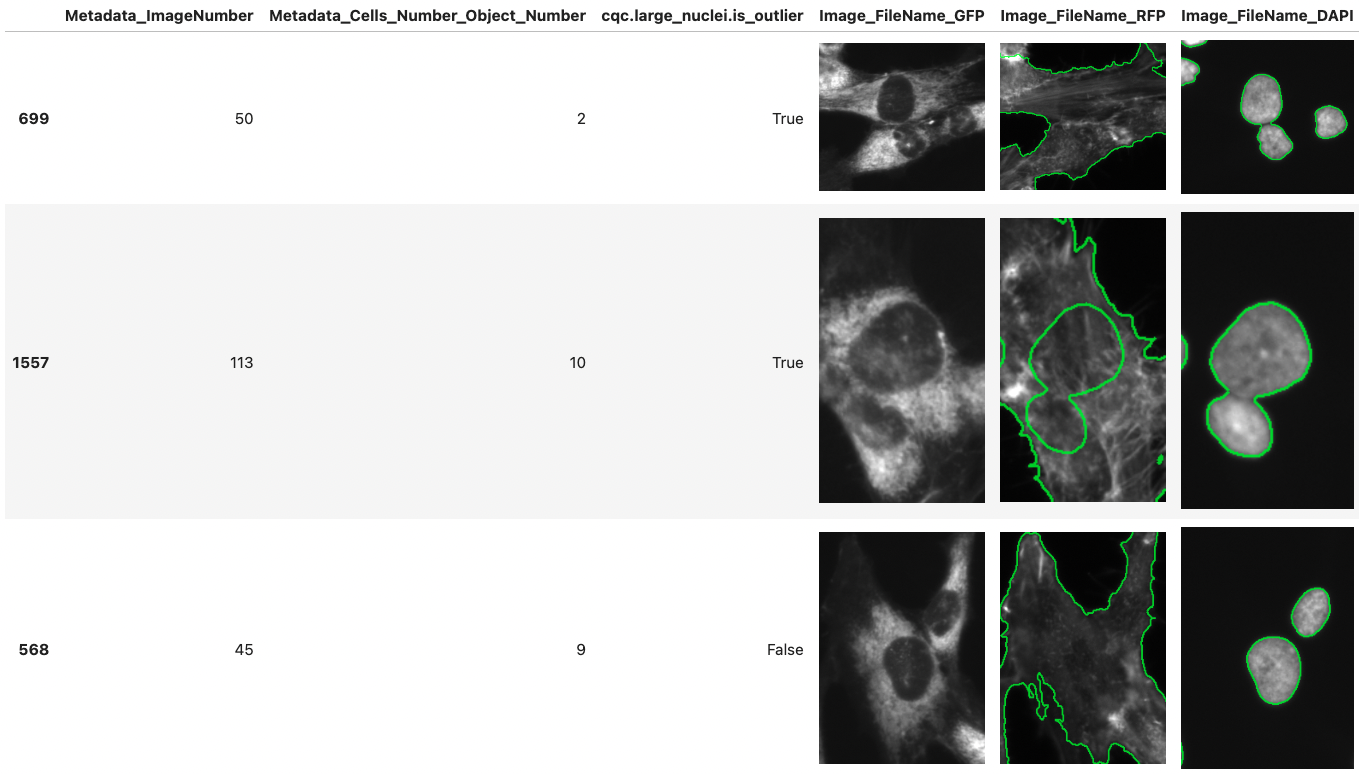
 CytoDataFrame extends Pandas functionality to help display single-cell profile data alongside related images.
CytoDataFrame is an advanced in-memory data analysis format designed for single-cell profiling, integrating not only the data profiles but also their corresponding microscopy images and segmentation masks. Traditional single-cell profiling often excludes the associated images from analysis, limiting the scope of research. CytoDataFrame bridges this gap, offering a purpose-built solution for comprehensive analysis that incorporates both the data and images, empowering more detailed and visual insights in single-cell research.
CytoDataFrame is best suited for work within Jupyter notebooks. With CytoDataFrame you can:
- View image objects alongside their feature data using a Pandas DataFrame-like interface.
- Highlight image objects using mask or outline files to understand their segmentation.
- Merge multiple channels into a single single-cell crop composite (similar to a Fiji composite) with
display_options={"composite_channels": "all"}or a per-channel color mapping such asdisplay_options={"composite_channels": {"OrigDNA": "cyan", "OrigRNA": "#ff00ff"}}(colors may be names, hex codes, or RGB tuples; cyan/magenta/yellow read more clearly than red/green/blue where channels overlap). A color legend is shown with the table, anddisplay_options={"equalize_clip_limit": 0.01}gives a milder, less over-saturated result. - Adjust image displays on-the-fly using interactive slider widgets.
- Display image objects even when bounding box columns are missing, by cropping from compartment-center offsets or rendering whole fields of view.
- Automatically detect 3D image volumes and render interactive trame views in notebooks when 3D dependencies are installed (with graceful fallback otherwise).
- Interoperate with the Polars and Apache Arrow ecosystems while keeping the familiar Pandas-based experience.
CytoDataFrame uses Apache Arrow as its canonical schema/interchange contract. Polars is the execution engine for lazy/scalable queries. Pandas remains the compatibility layer that CytoDataFrame itself is built on. You can move between all three representations, and run lazy queries, without leaving the CytoDataFrame API:
from cytodataframe import CytoDataFrame

# Construct from pandas, polars (DataFrame or LazyFrame), or a pyarrow Table.
cdf = CytoDataFrame("profiles.parquet")

# Convert to any representation. Pandas is CytoDataFrame's compatibility
# boundary (CytoDataFrame is a pandas.DataFrame subclass internally), so
# `to_pandas()` just returns a plain, un-subclassed pandas.DataFrame view of
# the same data; the other `to_*` calls convert it into that library's type.
cdf.to_pandas()  # pandas.DataFrame
cdf.to_polars()  # polars.DataFrame
cdf.to_arrow()  # pyarrow.Table
cdf.to_lazy()  # CytoLazyFrame (lazy, Polars-backed)

# Inspect the inferred schema (metadata / feature / geometry roles), e.g.:
# CytoSchema(image_key='Image_FileName_DNA', object_key='Metadata_ObjectNumber',
#            metadata_columns=[...], feature_columns=[...],
#            geometry_columns=[...], image_columns=['Image_FileName_DNA'])
cdf.cyto_schema
Large Parquet datasets can be scanned lazily rather than loaded into memory up
front. Polars only reads the rows/columns it actually needs once .collect()
runs ("predicate pushdown" for the .filter(...) row condition, "projection
pushdown" for the columns .select_features() keeps):
import polars as pl
from cytodataframe import CytoDataFrame

result = (
    CytoDataFrame.scan_parquet("profiles.parquet")
    .filter(pl.col("Metadata_Well") == "A01")
    .select_features()
    .collect()  # -> CytoDataFrame
)
For 3D notebook display behavior:
- 3D-aware rendering is enabled by default (
display_options={"auto_trame_for_3d": True}). - Disable automatic trame switching with
display_options={"auto_trame_for_3d": False}. - Force trame layout regardless of auto-detection with
display_options={"view": "trame"}.
For images without bounding box columns (e.g. older CellProfiler outputs or image-level data):
- Crop from compartment-center coordinates plus pixel offsets with
display_options={"offset_bounding_box": {"x_min": -20, "y_min": -20, "x_max": 20, "y_max": 20}}(requires compartment center columns such asNuclei_Location_Center_X/Y). - Render the full field of view without cropping with
display_options={"render_whole_image": True}(works even with no bounding box and no center columns).
For row display in notebook/widget tables:
- CytoDataFrame respects pandas display settings (
display.max_rows,display.min_rows). - When the table is larger than
display.max_rows, the widget table inserts a midpoint ellipsis row (…) to indicate omitted rows. - You can control truncation behavior by changing pandas display options before rendering.
📓 Want to see CytoDataFrame in action? Check out our example notebook for a quick tour of its key features.
✨ CytoDataFrame development began within coSMicQC - a single-cell profile quality control package. Please check out our work there as well!
Install CytoDataFrame from source using the following:
# install from pypi
pip install cytodataframe

# or install directly from source
pip install git+https://github.com/cytomining/CytoDataFrame.git
The core install is intentionally lean. Heavier, feature-specific stacks are available as optional extras:
# interactive 3D volume rendering (trame / pyvista)
pip install "cytodataframe[viz3d]"

# OME-Arrow image read/write/embedding (to_ome_parquet, OME-Arrow columns)
pip install "cytodataframe[ome]"

# everything
pip install "cytodataframe[all]"
Everything else in CytoDataFrame (including its Jupyter table/image display)
works without these extras. If you skip them, calling a feature that needs
one - to_ome_parquet(), or 3D rendering when pyvista/trame aren't
installed - raises an error naming the missing package and the extra to
install, rather than failing silently.
Please see our contributing documentation for more details on contributions, development, and testing.