

A flexible Python library for multi-armed bandit algorithms supporting regret minimization, best-arm identification, and variance minimization in both online and batched modes.
The name is a nod to Mancur Olson.
Requires Python >= 3.10.
# Development installation
make setup            # uv sync --extra dev

# Production (when published)
uv pip install rovingbanditimport numpy as np
from rovingbandit import (
# environment
BanditEnvironment,
# objectives
RegretMinimization,
# runner
OnlineRunner,
# algorithms
ThompsonSampling,
EpsilonGreedy,
UCB1,
RandomPolicy,
)
import matplotlib.pyplot as plt
env = BanditEnvironment(
n_arms=5,
arm_means=np.array([0.1, 0.3, 0.5, 0.4, 0.2]), # arm 3 is the best arm
seed=42,
)
policies = {
"Random": RandomPolicy(n_arms=5, seed=42),
"Greedy": EpsilonGreedy(n_arms=5, epsilon=0.0, seed=42),
"Epsilon-Greedy": EpsilonGreedy(n_arms=5, epsilon=0.1, seed=42),
"UCB1": UCB1(n_arms=5, seed=42),
"Thompson": ThompsonSampling(n_arms=5, seed=42),
}
objective = RegretMinimization(optimal_reward=0.5)
runner = OnlineRunner()
fig, axes = plt.subplots(1, 2, figsize=(14, 5))
result = {}
# run each policy and plot
for name, policy in policies.items():
env.reset_rng(42)
result[name] = runner.run(policy, env, n_steps=1000, objective=objective)
print(
f"{name:15} | Final Regret: {result[name].final_regret:.2f} | Avg Reward: {result[name].average_reward:.3f}"
)
result[name].plot(metric="cumulative_regret", ax=axes[0], label=name)
result[name].plot(metric="average_reward", ax=axes[1], label=name)
axes[0].legend()
axes[0].set_title("Cumulative Regret Over Time")
axes[1].legend()
axes[1].set_title("Average Reward Over Time")
# Random | Final Regret: 194.00 | Avg Reward: 0.306
# Greedy | Final Regret: 103.00 | Avg Reward: 0.397
# Epsilon-Greedy | Final Regret: 28.00 | Avg Reward: 0.472
# UCB1 | Final Regret: 75.00 | Avg Reward: 0.425
# Thompson | Final Regret: 33.00 | Avg Reward: 0.467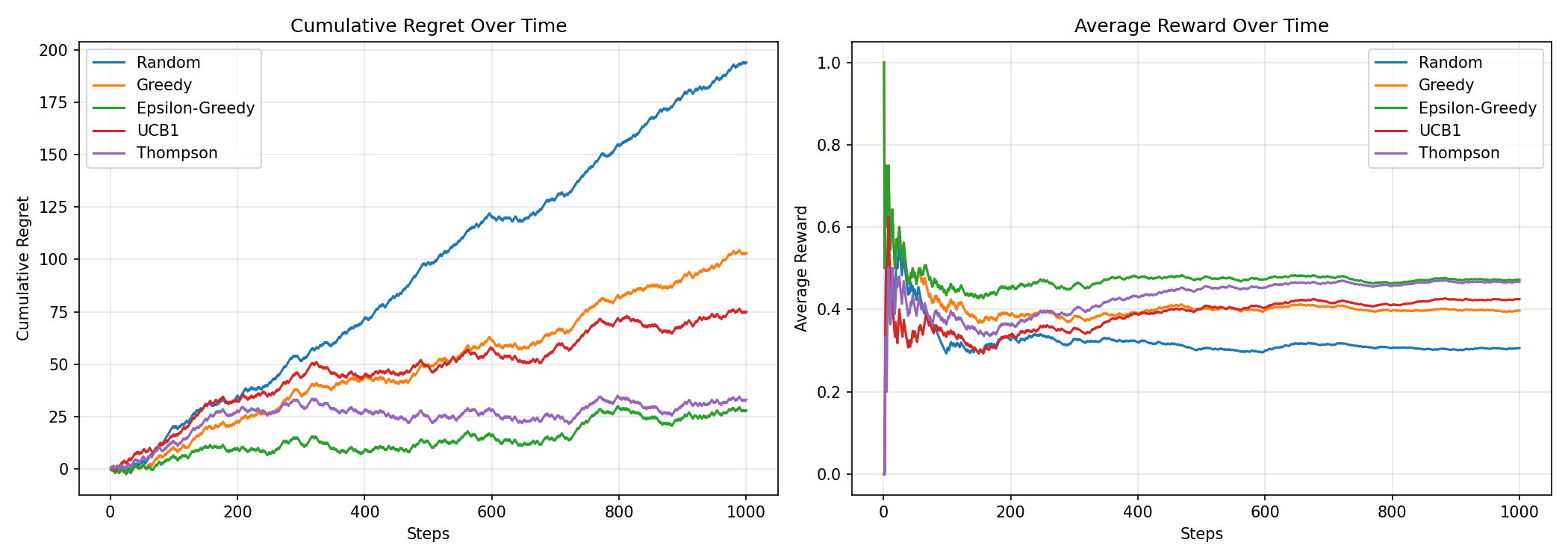
We can also visualize the sequence of arms pulled by each policy:
f, ax = plt.subplots(3, 2, figsize=(15, 10), sharex=True, sharey=False)
# plot arm pulls for each policy
for i, (name, res) in enumerate(result.items()):
    res.plot(
        metric="arm_pulls",
        ax=ax[i // 2, i % 2],
    )
    ax[i // 2, i % 2].legend()
    ax[i // 2, i % 2].set_title(f"Arm Pulls Over Time - {name}")
f.delaxes(ax[2, 1]) # delete unused subplots
f.tight_layout()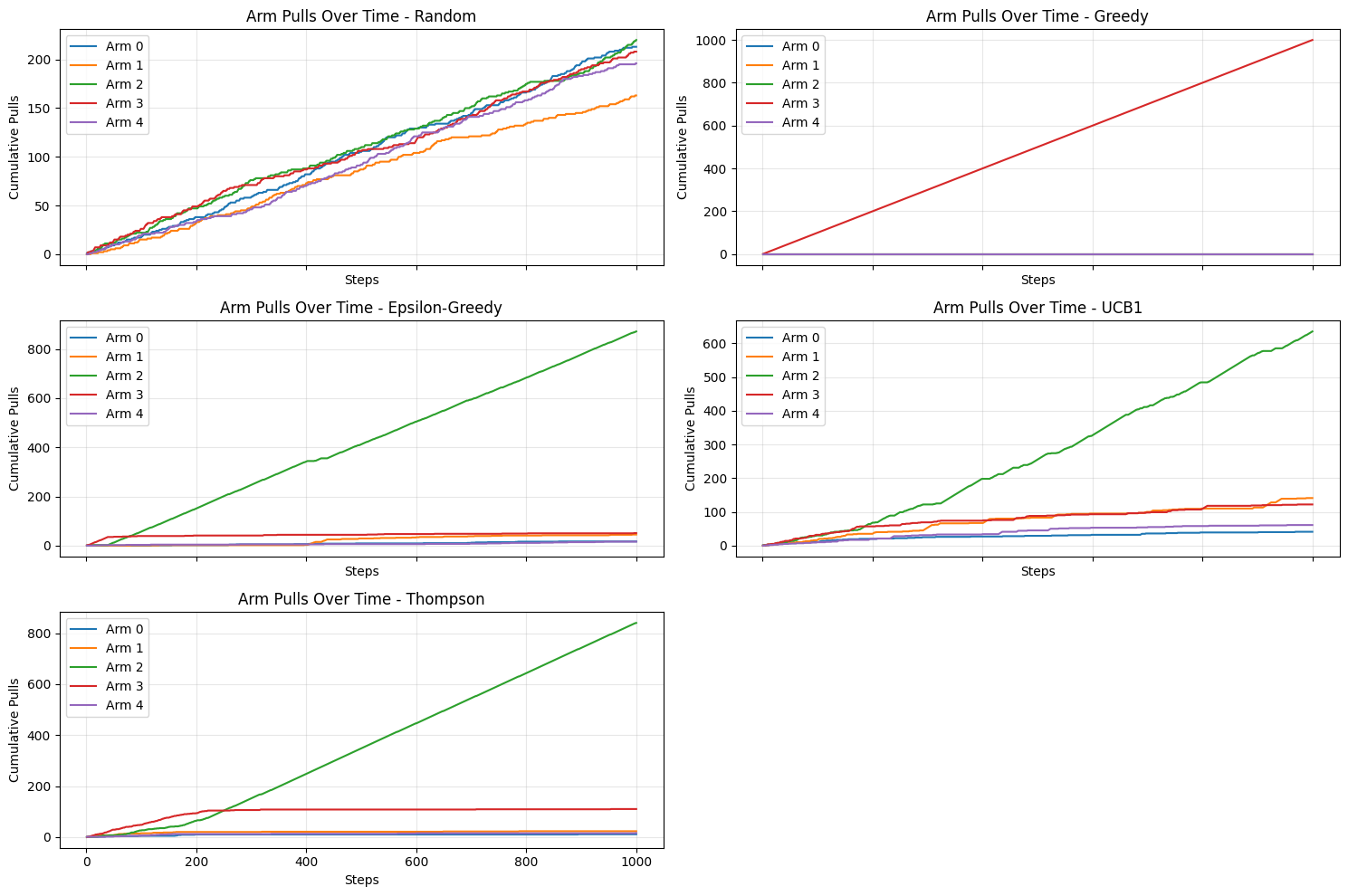
Core
- Clean separation of
Policy,Objective,Environment, andRunnerclasses - Online and batched execution modes; budget support; early stopping hooks
- Tests passing (~60% overall coverage; >80% on new code)
Available Policies
RandomPolicy,GreedyPolicy,EpsilonGreedy,ExploreFirstUCB1,ThompsonSamplingTopTwoThompson,LUCBfor best-arm identificationBudgetedUCB,BudgetedThompsonSamplingEpsilonNeymanAllocation(Neyman allocation with explore-then-allocate)KasySautmann(welfare-constrained variance minimization)RepresentationBandit(dynamic cost scaling for targets)LinUCB(linear contextual UCB)
Objectives
RegretMinimizationBestArmIdentificationVarianceMinimization
Runners
OnlineRunner(sequential, budget-aware)BatchedRunner(parallel)
Legacy Functions (backward compatibility)
pick_arm(),sim_runner(),arm_sequence(),pull_sequence()best_arm(),rep_bandit_cost(),rep_bandit_rake()
Planned Extensions
- SuccessiveElimination for best-arm identification
- Neural/contextual bandits beyond LinUCB
- Non-stationary variants (discounted, sliding window)
- Combinatorial actions
- Policy comparison utilities
See examples/basic_usage.py for complete examples:
# 1. Regret minimization - compare multiple policies
policies = {
    "UCB1": UCB1(n_arms=5),
    "Thompson": ThompsonSampling(n_arms=5),
    "EpsGreedy": EpsilonGreedy(n_arms=5, epsilon=0.1),
}
# Thompson achieves 83% less regret than random baseline

# 2. Best-arm identification with early stopping
result = runner.run(
    policy, env, n_steps=2000,
    objective=BestArmIdentification(confidence_threshold=0.95),
    early_stopping=True
)
# Identifies best arm in just 43 samples with 95% confidence

# 3. Budget-constrained bandits
result = runner.run_with_budget(
    policy, env, budget=100.0, pay_on_success=False
)

# 4. Batched (parallel) mode
runner = BatchedRunner()
result = runner.run(policy, env, batch_size=10, n_batches=50)

# 5. Variance minimization with group representation
objective = VarianceMinimization(target_shares=np.array([0.5, 0.5]))
result = runner.run(policy, env, n_steps=500, objective=objective)src/rovingbandit/
├── core/ # Base abstractions
│ ├── environment.py # BanditEnvironment
│ ├── policy.py # Policy base class
│ ├── objective.py # Objective base class
│ └── result.py # Result & History
├── policies/ # Algorithm implementations, grouped by objective
│ ├── regret_minimization/ # random, greedy, epsilon_greedy, explore_first,
│ │ # ucb, thompson_sampling, budgeted_*, linucb
│ ├── best_arm_identification/ # top_two_thompson, lucb
│ └── variance_minimization/ # epsilon_neyman, kasy_sautmann, representation_bandit
├── objectives/ # Goal definitions
│ ├── regret_minimization.py
│ ├── best_arm_identification.py
│ └── variance_minimization.py
├── runners/ # Execution modes
│ ├── online.py
│ └── batched.py
└── banditry.py # Legacy implementation
The set of policies is growing; see SPEC.md for planned additions. Basic structure is in place for future extensions.
# Install dev environment (uv + dev extras)
make setup

# Run tests
make tests

# Run all pre-commit hooks (ruff, ty, ...) via prek
make lint            # uv run prek run --all-files
Code quality is enforced with ruff (lint + format) and
ty (type checking), orchestrated by
prek using .pre-commit-config.yaml. CI runs the hooks and
the test suite (Python 3.10 and 3.14) on every push and pull request.
- Clean OOP design - Composable policies, objectives, and environments
- Academic rigor - Algorithms based on peer-reviewed research with references
- Multiple objectives - Regret minimization, best-arm ID, variance minimization
- Flexible execution - Online (sequential) and batched (parallel) modes
- Budget constraints - Native support with pay-on-success options
- Early stopping - Automatic termination when objectives met
- Full backward compatibility - Legacy API still works
- Type hints - Complete type annotations throughout
- Well tested - 25+ tests with >80% coverage of new code
- Vectorized operations where possible
- Efficient incremental mean updates
- Minimal memory overhead
- Preliminary benchmarks show 3-5x speedup over naive implementations
- This README - quickstart and API overview
SPEC.md- detailed architecture specification with academic referencesdocs/algorithms.md- mathematical and algorithmic reference- Inline docstrings - all public methods documented
examples/- comprehensive usage examples- Tests - serve as additional documentation
Key papers (see SPEC.md for full bibliography):
- UCB: Auer et al. (2002) - Finite-time analysis of the multiarmed bandit problem
- Thompson Sampling: Chapelle & Li (2011) - An empirical evaluation of thompson sampling
- Best-Arm ID: Russo (2016) - Simple Bayesian algorithms for best arm identification
- Variance Min: Kasy & Sautmann (2021) - Adaptive treatment assignment in experiments
MIT
This library is under active development. Contributions welcome, especially:
- New policy implementations
- Additional objectives
- Performance optimizations
- Documentation improvements
See SPEC.md for planned features and implementation roadmap.